Showing posts with label marriage equality. Show all posts

Sunday, June 19, 2016

How the Church Built the Argument for Marriage Equality ... Pill by Pill and Condom by Condom

One of the arguments made by the LGBQT community over the question of marriage definition risks resembling a jeremiad from a Church father against the Church contemporary. Supporters of traditionally defined marriage invoke the important aspect of marriage to the stability of how children are reared, to the interest in creating a legal framework within which couples conceive and bear children. From that view, marriage is about as related to same sex relationships as are fish to bicycles. Because simply by saying that I may offend, I mean that in our current biological state, a physical act of union might occur in three separate kinds of two-person couplings: between two men, between two women, between a man and a woman. Despite popular headlines about a transgendered man giving birth, which involved a biologically female person that identified as a male, only the male-female couple is independently capable of fecundity. Men only in a physical act of coupling never become pregnant. Women only in a physical act of coupling never become pregnant. So, essentially, this particular argument against redefining marriage reflected the erection and maintenance of social and legal structures to assist the fecund in procreating, bearing, and raising children. The LGBQT community offered several answering arguments. For example, they argued that, with sperm donation, artificial insemination, and adoption, gay couples and lesbian couples too could become the parents of children needing the supporting social and legal structures of marriage. Of course, much offense -- whether intended or not, well-founded or not -- was created when traditional marriage advocates contended that recognizing and normalizing same sex marriage would institutionalize a harm for children, namely that they would be denied thereby the best possible outcome by being denied a stable, opposite sex couple as parents. Another argument made by the LGBQT community for recasting the institution of marriage was that, de facto, society had already has recast marriage. By that, they did not imply that society redefined marriage to include same sex couples. Rather, they meant that society had opened marriage to include opposite sex couples that were not physically capable of producing, or even possibly likely to see, offspring result from a physical act of union. Think of it: we have elderly couples -- who meet in Senior Living communities -- falling in love and marrying. But the wife will have long since passed menopause and be infertile and for the husband, unless the little blue pill or its variants are available, the ability to successfully conduct the unitive act is likely to be substantially degraded. We have scarlet fever victims who marry -- just as George Washington -- whose illness was, effectively, a biological vasectomy. And we have survivors of uterine and ovarian and testicular cancer that marry, even though they can never produce offspring. Yet society was not asking Fred if he had been mechanically castrated by a farm accident or Wilma if she had survived ovarian cancer but had lost her ovaries. In these circumstances, society was testifying that procreation was no more than "a part" of the reason for marriage, and, indeed, not so significant a part as to insure that there was at least a biological possibility of producing offspring.
One argument that I never saw in the long battle over same sex marriage was that society had also testified loudly and proudly against this very interest by helping to develop, to widely distribute, and to make moral the use of artificial contraception to control fertility. Yet, and I realize again that I may be stepping on toes, by the widespread teaching and availability of artificial birth control, by its acceptance in churches, by its use in marriage, they do exactly that. They testify to a certain perspective, namely that marriage isn't always, or even principally about, fecundity and the bearing and rearing of children. Some who've read this far will suspect that I am foisting a falsity on them, the falsity being that there was ever a time when churches generally agreed that artificial contraception and abortion violated God's design for marriage. It's a funny thing, that. A thing becomes so commonplace that one disputes that another condition -- the absence of that thing -- ever existed. For example, I recently saw a Tweet from a knucklehead who queried in a Twitter post why old push button home phones had a hashtag ("#") key, when Twitter wasn't even invented until 2006? Well, in much the same way, Christian folk who are not versed in the history of our society nor in the teachings of the church over time may suspect that, setting aside the rather bizarre Roman Catholics, all other Christian denominations had always recognized that artificial contraception was an important tool for married couples. The fact is that, until very modern times there was little dispute amongst the denominations about the nature and purposes of marriage, and that, as such methods became available, the use of artificial contraception struck a defiant note against God's design. Let me take an aside here. Do you enjoy C.S. Lewis? Perhaps his Chronicles of Narnia, or some of his nonfiction? I'll start with an honest confession. I have read **some** C.S. Lewis, specifically Mere Christianity, The Great Divorce, and Mere Christianity. I also read his Space Trilogy, Out of the Silent Planet, Perelandra, and That Hideous Strength. Here's the confession, I tried and tried to read The Chronicles of Narnia, but I just never was captivated by them as I was with his Space Trilogy or with J.R.R. Tolkien's Ring Saga. But I loved Lewis' Space Trilogy, loved it and read and re-read it.
The last book in the trilogy is, essentially, apocalyptic literature. It speaks of a great confluence between forces of good and forces of evil. I recommend the trilogy for a good summer read, and I heartily recommend That Hideous Strength. In That Hideous Strength, there is a scene that relates to my musings here. Allow me to relay it to you: As the forces of evil and of good are separately drawing together and organizing, both look to the rediscovery and reintroduction into Britain of the legendary Merlin, of the Arthurian legends. In Lewis' version, Merlin, not dead, lies buried and awaiting a re-awakening. Evil believed that Merlin would join forces with it, but that reflected Evil's failed misinterpretation of history. Merlin seeks out and finds Good. It is in the finding of the fellowship of Good that the scene I have in mind occurs. Merlin is in the company of the man that leads the Good and that, like he, is part of an ancient order. As they are speaking in an ancient language, one of the book's protagonists, Jane, comes into Merlin's presence. Merlin discerns a truth about Jane, a youngish, and fairly recently married woman. That truth is that she and her husband have deliberately avoided conception of young in their physical couplings. Lewis leaves no doubt that Jane and her husband unite sexually. An earlier passage in the book pokes fun at how little time it takes for that shared activity to be completed and her husband to be soundly asleep. So, this wasn't a couple on the outs, withholding from one another in physical relations. Rather, as Merlin discerned the matter, this was a deliberate defiance of the Creator's plan. Lewis wrote the passage thus:
"Up to the first landing they were in darkness; on the second and last the light from the first floor fell.
"Looking down on them from the balustrade were two men, one clothed in sweepy garments of red and the other in blue. It was the Director who wore blue, and for one instant a thought that was pure nightmare crossed Jane's mind. The two robed figures looked to be two of the same sort. . . and what, after all, did she know of this Director? And there they were, the pair of them, talking their secrets, the man who had been dug up out of the earth and the man who had been in outer space. . . . All this time she had hardly looked at the Stranger. Next moment she noticed his size. The man was monstrous. And the two men were allies. And the Stranger was speaking and pointing at her as he spoke.
"She did not understand the words: but Dimble did, and heard Merlin saying in what seemed to him a rather strange kind of Latin:
"Sir, you have in your house the falsest lady of any at this time alive."
And Dimble heard the Director answer, "Sir, you are mistaken. She is doubtless like all of us a sinner: but the woman is chaste."
"Sir," said Merlin, "know well that she has done in Logres a thing of which no less sorrow shall come than came of the stroke that Balinus struck. For, sir, it was the purpose of God that she and her lord should between them have begotten a child by whom the enemies should have been put out of Logres for a thousand years."
"She is but lately married," said Ransom. " The child may yet be born."
"Sir," said Merlin, "be assured that the child will never be born, for the hour of its begetting is passed. Of their own will they are barren: I did not know till now that the usages of Sulva were so common among you. For a hundred generations in two lines the begetting of this child was prepared; and unless God should rip up the work of time, such seed, and such an hour, in such a land, shall never be again."
"Enough said," answered Ransom. "The woman perceives that we are speaking of her."
"It would be great charity," said Merlin, "if you gave order that her head should be cut from her shoulders; for it is a weariness to look at her.""
So there you have it, Jane and her husband, though fecund in the strict sense of capacity, had made themselves barren.

Nor was theirs a conscienceless coupling like rabbits. The backstory reveals both a church wedding, and an intimate recall on Jane's part, at least, of the vows she spoke.
I mention C.S. Lewis for my Christian friends who may think what I am saying about artificial contraception is solely a matter of concern for Catholics, and doesn't reflect a teaching common to Christian churches in any era of church history. While C.S. Lewis enjoyed a great friendship with the Catholic author Tolkien, Lewis was no Catholic. He was, however, both a Christian, and a learned man. My surmise is this: the controversial Lambeth Conference of Anglican Bishops of 1930 admitted for the first time that certain circumstances might warrant artificial contraception and avoidance of pregnancy in a Christian marriage. The Lambeth Conference was highly controversial and both the product of and instigator of conversation about human sexuality and marriage. When Lewis published the Space Trilogy the 1930 Conference was just fifteen years past, certainly it was even more recent while he was in the process of writing the series. Lewis followed the Lambeth Conferences. We know that he did. He wrote a letter to the 1948 Conference on the topic of admitting women to Anglican priesthood. I think Lewis perceived the moral error of Lambeth, of teaching that salting the womb could be a moral right. And so, when the unleashed terror of holy judgments -- Merlin -- is restored to life and perceives the self-inflicted infertility, he simply states what is, to him, obvious. Here there is a gross moral imbalance.
Now, do I think you should draw your moral theology from, or solely from, the fiction of C.S. Lewis? Hardly. The point of the story's use here is Lewis' use of the commonplace recognition of God's role in the marital bed and procreation, and the offensiveness of asserting an essentially atheistic autonomy in the face of what had been designed by God. Returning to the topic on which I began writing, there are vials and vials of expended bile in the word wars between those that support and those that oppose expanding the definition of marriage to include same sex couples. I haven't seen, however, any acceptance of (im)moral responsibility on the part of churches and Christians for their own abandonment of God's marital designs and their own personally justified rebellions against God's purposes in their lives. I suppose that if Churches and Christians hope for a revival and reversal of fortunes in the land, they might begin with profound repentance to God for turning away from Life's door the living gifts they rejected in contraception and abortion. Until they do, they will always be weakened by their own insistence on defiant autonomy.

Friday, July 24, 2015

A Satchel of Embarrassments: Anthony Kennedy and Obergefell v. Hodges


Anthony Kennedy
Justice Kennedy authored the opinion for the Court in Obergefell v. Hodges. He wrote the words, quoted by Justice Scalia, "The Constitution promises liberty to all within its reach, a liberty that includes certain specific rights that allow persons, within a lawful realm, to define and express their identity,"

In Obergefell, the Supreme Court concluded that the right to marry constituted a right that was "fundamental" under the federal Constitution. Because the right is fundamental, it violates the Due Process Clause of the Fourteenth Amendment to deny access to the right to marry to persons seeking to create same sex marriages on the same bases and terms under the laws of the States as those laws provided for the creation of opposite sex marriages. The decision has been immediately and widely hailed for its result. Obviously those who do not view the Constitution as empowering the federal government to interfere in the power of the States to regulate domestic institutions like marriage, and those that oppose the concept of same sex marriage did not join in the hoopla.

Still, even among those that welcomed the outcome of the case, there were those who looked for, but did not find, the precise decision for which they hoped. The Court did not decide that all discrimination between heterosexual orientation and homosexual orientation is, in its nature, invidious. Nor did the Court conclude that such forms of discrimination were subject to strict scrutiny, as are

The problem with Justice Kennedy's opinion in Obergefell is that is without connection to the plain text of the Constitution, or its history, or its construction by the Supreme Court for the history of the Court from the ratification of the Fourteenth Amendment up until the decision of the Court in Obergefell. Does it matter that Kennedy's opinion reflects his conclusion (albeit without expressly stating it) that he was deputized by the Constitution to sit in judgment of the power of the States in areas of human interaction expressly reserved to them under the Tenth Amendment?

I think that it matters that those that ratified the Constitution, and those that ratified the Fourteenth Amendment, did not deputize the Justices of the Supreme Court to sit in judgment of the exercise of the powers reserved to the States and to the People. The consequence of Justice Kennedy's opinion for the Court is a further erosion of the federal system by which aggregation of power is prevented by granting certain powers to the federal government, and retaining others in the States and in the People.

Sunday, June 21, 2015

When the Gods of The American Olympus Speak: The Uncertainty of Rights

"We hold these truths to be self-evident."

Do we? Do you?

The enterprise of our liberty, our independence, as a people, from Crown and Parliament, depended on the earnestness of those who proclaimed that they held those views. If they were not, as free, moral, agents convinced that they and their fellows were possessed of a body of rights that they could not even agree to surrender (inalienable), then their pretense of offense at the tyranny of the English Crown and Parliament was just that, pretense on pretense. Rather than conclude against evidence that the Declaration of Independence was an insincere statement posturing about aspirations, I take Jefferson and the signers of it at their word.

Who we are, as a People, can be stated in many ways. A law professor with whom I occasionally debated back when newsgroups were a key way to communicate on the Internet often referred to America as the Protestant Empire; that phrase succinctly stated the exclusivity of the Protestant view shared among the principal founders, and among the States, throughout much of our Nation's history. Of course, others use the term "melting pot" and identify the Nation as, essentially, mongrels, the world's "mutts" if you will.

Certainly there will be great disagreement in such categorizations. But the Declaration speaks for me. We are a People convinced that each of us, at the hand of Nature and Nature's God, are endowed with rights that belong to us in time before there is even a political body such as this Nation to get into the business of "granting" such rights. In other words, our right to live, it does not exist because our particular State and the United States have told us we may live. Likewise our rights to liberty and to pursue happiness.

Still, the Declaration, while it gives us an identity as a People, does not state a set of organizational principles by which a common enterprise such as a political community can be stood up and can be maintained.

For those principles, we have looked to Constitutions, first, the Constitutions of the States (as they preceded in time and right the general government) and second, the Constitution of the United States. These documents frame our governments. They confirm powers of the government (or in the case of the federal government, they confer those powers on the general government). They acknowledge the existence of, and inviolability of, the rights with which the Declaration says we are each endowed.

Throughout the entire course of our constitutional history, a struggle has existed over the question of how to govern the whole body of us. Lincoln spoke to this question in his First Inaugural Address. Remember, to render this address on the assumption of his duties, Lincoln had first to sneak into Washington, DC, coming from Illinois, by rail, through the border State of Maryland, which never seceded but which had preferred his opponent, John Breckenridge, a Southern Democrat, in the general election. So, in his inaugural address, with threats and moves toward secession spoken openly, he made his appeal for Union.

In that appeal, he explained how the conflicting views created issues of how the Nation could be governed. In his view, secession was the minority opinion. And, as he viewed it so, he explained that it was not, by any sense of political power or duty, entitled to a permanent circumstance of governing over the majority:
Plainly the central idea of secession is the essence of anarchy. A majority held in restraint by constitutional checks and limitations, and always changing easily with deliberate changes of popular opinions and sentiments, is the only true sovereign of a free people. Whoever rejects it does of necessity fly to anarchy or to despotism. Unanimity is impossible. The rule of a minority, as a permanent arrangement, is wholly inadmissible; so that, rejecting the majority principle, anarchy or despotism in some form is all that is left.

Ultimately, what we have is not a finely tuned machine, with exceeding close, "German engineering" tolerances. Instead, we have republican (little "R") government by which, in fact, our law and policy is made by representatives of the people, not the people themselves. Moreover, that republican or representative government does govern by principles of majority rule. With respect to the choices to made in laws to enact, laws to repeal, and the like, the essential governing principles are two:

First, the majority is free to make laws, or to repeal laws, touching upon the host of human experience and interactions, so far as, and to the extent that, the majority chooses to do so.

They can adopt a law requiring that leaves be bagged and placed at the curb. They can pass a law requiring that cars undergo an annual safety inspection. The only requirement preceding a legitimate exercise of this general right of legislative majorities is that there be an underlying rationale for their law that survives a minimal kind of scrutiny often called the rational basis test. So, for the leaf bagging requirement, a county commission might pass just such an ordinance after hearing testimony from the rainwater runoff commission that leaves piled in street-side gutters result in clogged rainwater drains.

Second, the majority is barred from making laws in selected categories.

The majority cannot make laws that target certain kinds of minority groups for disfavored treatment (so, for example, they majority cannot require that all Asians register with the police department, or that all Norwegians register with the Farm Bureau). Such laws violate the principle of equal protection of the law. The majority could, for example, pass a law requiring EVERYONE to undertake some ministerial act, for example, attend school. In fact, such laws are widespread, rampant, familiar.

The majority is also barred from making laws that burden the exercise of certain essential, political and civil rights, rights that we often associate with the Bill of Rights, such as the right to freedom of speech, the right to free exercise of religion, the right to keep and bear arms. It doesn't matter that the Congress or your State assembly pass a law that restricts every one's right to gun ownership -- as opposed to a law prohibiting only Caucasian females from owning -- it is the underlying, affected right that is of particular concern and that is particularly prized and protected.

Given that background, and as we are, or may be, on the cusp of a stunning decision of the Supreme Court on a question of law that has always been, until in recent time, readily recognized as belonging to the sphere of States' powers rather than the federal government's powers, I think it of great importance to see how a nation is being held hostage to the opinion of, essentially, a single man.

The American Olympus

Let's start with this atmospheric:

Here are the remains of the Parthenon, the Temple of Athena, the Greek Goddess of Wisdom. By legend she sprang full grown from the head of Zeus. Nearly two and a half millenia later, the Athenian devotion to her wisdom is evident in the structure.


Yes, damaged. Crumbling. But who isn't after a couple millenia. Now, compare that remarkable temple with this one, the United States Supreme Court, which was constructed in the manner it was, for the purpose of creating a sense of it as a judicial Olympus:


Comparing the two leaves you the impression that the only real difference is that the Supreme Court required more space for staff than did Athena.

And, it isn't that the building resembles a Greek temple, accidentally. Cass Gilbert, architect of the structure, "literally conceived of [it] as the temple of justice...." "Finished and occupied in 1935, the Supreme Court is meant to resemble a great marble temple."

Literally, the face of the Court to the Nation is that the Court is our American Olympus. With the passage of time, and the accretions of power within our constitutional framework of government, the Court's decisions are often difficult to perceive differently than the rolling of thunder and bolts of lighting from legendary Olympus.

If you haven't listened to the oral argument recently had before the Supreme Court on the cases involving the claimed constitutional right to "marriage equality," the legal principles and language are not so arcane, so full of legal jargon, as to be beyond comprehension. You could, if you wished, listen to those arguments, here (part one) and here (part two). It's a good bit more work to wade through the briefs and the many additional filings by interest groups supporting and opposing the claimed constitutional right to marriage equality. But were you to do so, you would immediate recognize that there is one "pretty girl" in the "gym" of the Supreme Court's argument, only one justice for whose vote every legal "suitor" pines and yearns: Justice Anthony Kennedy.

Kennedy, just like moderates preceding him, is often targeted by the authors of briefs and the presenters of arguments. Not targeted in a bad sense, but targeted in the sense of being the one to be convinced, to be wooed in words. And the media reports recognize that this case likely depends on Kennedy's vote. Here are some examples of such media reports:
The decision is likely to come down to the court's key swing voter, Justice Anthony Kennedy, or Justice John Roberts, who once sided with the liberals in the case that upheld Obamacare.
He said the more conservative justices - Antonin Scalia, Clarence Thomas and Samuel Alito - are likely to rule against gay marriage. And the more liberal justices - Elena Kagan, Ruth Bader Ginsburg, Stephen Breyer and Sonia Sotomayor - are expected to support it. Feldman said Justice Anthony Kennedy and potentially Chief Justice John Roberts could be the deciding votes.
The four liberal justices are expected to support same-sex marriage, and conservative Justice Anthony Kennedy, the expected swing vote, has a history of backing gay rights. In three key decisions since 1996, Kennedy has broadened the court's view of equality for gays. The most recent was a 2013 case in which the court struck down a federal law denying benefits to married same-sex couples.
All reports from the argument support the likely scenario that Justices Breyer, Ginsburg, Sotomayor and Kagan will vote to overturn the lower court decisions in the cases at the Court on the ground that the Constitution guarantees the right to marriage equality, and that Justices Roberts, Scalia, Thomas, and Alito will vote to affirm the decisions now pending before the Court. (Of course, we are supposed to reason that even though Justices Ginsburg and Kagan have officiated at same-sex marriages, their decisions on the legal question will proceed from constitutional grounds rather than personally biases.)

That leaves for prognosticators the all important question: how will Kennedy vote? 

Will Kennedy join the progressives on the Court and stunningly overturn the understood two hundred years plus interpretation of the Constitution and one hundred forty years reading of the Fourteenth Amendment, finding a right to marriage equality that guarantees that members of the same sex have same right to marriage as was previously recognized only for opposite sex couples? Or, will Kennedy join with Roberts, Scalia, Thomas and Alito, and hew the traditional lines of the Constitution?

No one, except the Justices and their staff members involved, has any idea for sure now. But shortly we will all know. And then, no matter how the case turns the howling will ensue. If Kennedy rejects marriage equality in this go-round, even if he leaves open the pathway toward its eventual recognition, the supporters of marriage equality will undoubtedly decry the injustice that they perceive in such a construction of the Constitution. If Kennedy joins the progressive justices on the Court and finds a constitutional right to same sex marriage, then the hue and cry from supporters of traditional marriage will, likewise, erupt.

So now, I am again thinking of the President I hate to love, the President I love to hate, Abraham Lincoln. And I'm thinking about the Nation that he "inherited" as President. Then, we were a nation fracturing over slavery, and reeling from a Supreme Court decision that rejected the power of Congress to restrict slavery in federal territories, a decision that denied the constitutional person hood of Africans. Then, his First Inaugural Address, he spoke to near half a Nation that hung precipitously on the cusp of secession, and to over half a Nation that had seemed content to leave slavery where it found it, maintain Free Soil principles where they established them, and work toward political solutions when possible. His address served as his appeal to heart and mind against the propriety of secession, and thus against the principle, as he would see it, of minority rule.

Today, his words would be directed to those who advocate marriage equality. While same-sex marriage has become legal in the majority of our States, the bulk of those changes were by reason of federal court decisions declaring State laws or State constitutional provisions restricting marriage to opposite sex couples to be unconstitutional as violations of the Fourteenth Amendment. In the absence of those judicial rulings, the vast majority of States prohibited anything other than opposite sex marriage. Lincoln, then and now, would urge that the better, more secure guarantee of the right for which they are contending through the Courts.

Remember that the Nation learned this lesson through a Civil War. An ill construction given to the Constitution by the Supreme Court, the election of a Radical Republican, and the feared loss of sovereignty in southern States, together with the moral question of slavery, precipitated that war. And that war created the conditions by which three amendments -- prohibiting slavery, guaranteeing citizenship to the newly freed slaves, and providing a right to vote -- could be added to the Constitution. And while the work of perfecting those repairs is not done, it has not been left mostly undone.

And that's why I keep explaining in this blog, and elsewhere. I know many stridently oppose redefining marriage to include same sex marriage. I know some fervently yearn for recognition of marriage equality under the Constitution. But neither group can rest securely in the outcome for which they hope when the outcome is granted by the oligarchs of the Supreme Court. The securest means of guaranteeing a right or preventing a wrong, in our constitutional society, is to AMEND the Constitution. Nothing else is a substitute for doing so. Otherwise, we will continue to wake up in Kennedy's America, or another Justice's America, and not our own.


Monday, June 1, 2015

We the Judges vs. We the People

When we are born, we lack the muscle strength and coordination to stand, to walk, and to run. We lack the teeth to bite, to tear, and to chew. We lack the visual acuity to discriminate among patterns.

These things -- for almost all of us -- do come. The joy of first sitting up by a child, first standing up, first steps will come. The delight of first solid food (at least until time to change the diaper). The thrill of the first words, "maaaa" or "dada."

But until these skills, and a host of other skill sets, switch on, and we hone and develop them, we have parents.

I don't care if you think we have parents as a feature of evolutionary biology or special creation, the point you cannot dispute is that young are nurtured by biological antecedents. This rule is not universal to the kingdom of animals, that parents engage in this nuturing to maturity. Many species engage in, essentially, lay and release. Think here of the images of turtles, freshly hatching on the beach, and making the dangerous dash to the sea. No mother to guard them, to guide them, they are the easy prey of men and beasts.

But, and this point is what brings me here today, there is a time when a being acquires the separate and equal station in life, to which the continuing application of infant parenting is entirely inappropriate. Think Jeff Daniels changing bearded Jim Carrey's diaper in Dumber and Dumber 2. And yet, gentle reader, this very inappropriate form of infant parenting is writ large across the American landscape. That infant parenting takes the form of judicial activism.

What bring this topic to mind?

Actually, a couple factors play into my mulling the topic.

First, Damon Root's piece in Reason magazine, which you can find here: When Judicial Activists Switched Sides. This article, in three brief pages, scopes out a history of the modern movement from self-government, that is, government by we the People through our elected legislative assemblies, to the governmental form of infant parenting, that is, rule by a judicial oligarchy. Root's pithy pitch makes clear the loss of self-government in the appeal by many different special interest groups to courts, particularly federal courts, on a host of disputed matters typically (historically) left to regulation by state legislatures.

Second, the pending cases before the Supreme Court on the subject of marriage put the question squarely before us:  given the separate sovereign status of the several States, and their retention under the Constitution of the plenary power to regulate the institution of marriage, can judicial interventions like the present cases (or, indeed, past cases such as Loving v. Virginia) be constitutionally justified?

Remember, no mere legal fiction, the separate status of the States as sovereign political bodies pre-existed the federation created by those States when they drafted and ratified the Constitution of the United States. To set up a workable arrangement of divisions of powers, the States made limited donations of their natural range of powers to the central or general government. At the same time, the States retained to themselves a broad swath of traditional State powers.

For example, the States retained the power to regulate public health, safety and morals (shocking, yes, but true, States have historically maintained -- as against any such power in the federal government -- the power to enact and enforce moral regulations). On the other hand, States entirely surrendered to the new federal government the power to enter into treaty relations with foreign powers. While the States, at the Nation's founding, retained the power to establish an official church, they specifically withheld a like power from the central or general government. On some matters, as allowed by the express terms of the Constitution, both the States and the central or general government share a power. One example of such a shared power is the power to tax. The States enjoy plenary power in this regard, the federal government enjoys such power to tax as allotted to it in the Constitution.

So, then, the questions related to regulation of marriage should begin where the Nation did, with the Constitution. Did the States donate any power related to the regulation of marriage to the federal government in the Constitution? There is no rational ground on which one may assert that they did so.

Failing to dive into the history of our Nation, failing to comprehend the comprehensive struggle leading to the ratification of the Constitution, cheats one of the ability to understand the significance of an act such as a federal court ordering a State to change its regulation of marriage. No one, not Hamilton, not Jay, not Madison (the authors of the Federalist Papers), NO ONE AT ALL, contended that the Constitution sent to the States for ratification allocated any power to the central or general government on the question of marriage (or, for that matter, on any topic not expressly stated in the Constitution). So, if the Supreme Court rules on the marriage cases, and confines itself to the Constitution as it was on the date it became effective (June 21, 1788, when New Hampshire became the ninth State to ratify it), then there is no legitimate basis for the Court to do otherwise than to rule that questions of marriage were reserved to the States and to the People in the drafting of the Constitution, and to affirm the cases before it (ones sustaining State laws limiting the definition of marriage to opposite sex couples).

But the Court won't confine itself to the 1788 Constitution.

Proponents of marriage equality base their case on another Constitution. That Constitution is the one resulting from the addition of the Fourteenth Amendment to the Constitution. That amendment cured the ill resulting from Dred Scott v. Sandford, a case in which the Supreme Court held that blacks were not, could never be, citizens of the United States under the Constitution. The Fourteenth Amendment made "all persons born or naturalized in the United States, and subject to the jurisdiction thereof" citizens of the Nation and of the State in which they reside. More than that, though, the Fourteenth Amendment imposed guarantees that newly minted citizens -- that large class of former slaves included -- enjoyed full participation in important aspects of citizenship. The amendment guarantees equal protection under the law, and due process rights prior to deprivation of rights to life, liberty or property.

So marriage equality advocates would have the Court find, within the requirements of equal protection and due process, a right of one person to enter into a marital relationship under State law with a person of the same gender. Now the Court will rule on the question. Its ruling will likely come before July 1, 2015. The Court will either affirm the decisions of the lower courts that are before it, or reverse those decisions. If the Court affirms, then States in those cases will remain free to regulate marriage, and to limit marriage to opposite sex couples. If the Court reverses, then the States in those cases, as the States in the many other cases in which courts have held that limits on marriage to opposite sex couples violate the Fourteenth Amendment, will be obliged to license both opposite sex and same sex marriage (or to exit the marriage licensing process entirely). (Occasionally, the Supreme Court fails to reach a decision on a particular case during the term in which it is argued; none of the factors typical to such cases, such as the retirement or death of a justice after argument, are present here.)

Damon Root's article linked above, in its closing paragraphs, quotes the late justice, Hugo Black. In 1968, Black expressed his views on the Constitution in lectures given at the Columbia University School of Law. What he said there stands today as a sound reminder of the dangerous dependency on allowing the Court to treat this Nation, these States, as overgrown babies requiring its particular brand of infant parenting through judicial abrogation of State laws:
[T]here is a tendency now among some to look to the judiciary to make all the major policy decisions of our society under the guise of determining constitutionality. The belief is that the Supreme Court will reach a faster and more desirable resolution of our problems than the legislative or executive branches of the government. To the people who have such faith in our nine justices, I say that I have known a different court from the one today. What has occurred may occur again. I would much prefer to put my faith in the people and their elected representatives to choose the proper policies for our government to follow, leaving to the courts questions of constitutional interpretation and enforcement. (Quoting H. Black, A Constitutional Faith at p. 11).
Black spent a lifetime in and around the Court. Read those words: "To the people who have such faith in our nine justices, I say that I have know a different court from the one today." How slender is the reed on which you wish to rest your rights? Many difficult cases of the Court, in areas such as criminal law, economic regulation, and constitutional rights, are decided by slender margins, five justices against four, sometimes by slenderer margins three or four justices deciding an outcome for one reason, joined by a couple justices agreeing with outcomes but rejecting reasons. Do you rest comfortably knowing that the rights you hope to celebrate are a justice's breath from extinction?

If, like Black, like Lincoln, like Jefferson, you recognize that government by judiciary is unsound in principle and ephemeral in fact, then you will not celebrate a decision of the Supreme Court striking down State laws on marriage. Even those that support marriage equality must rest uncomfortably in such cases. Our more secure rights are secure because they rest on the acceptance and shelter of the great body of the People of the states in which we live. And, but for the limited class of matters over which the States permit the federal government to have rule, the soundest place for policy judgments is in the great, unwashed herd, that are We the People.

Thursday, April 30, 2015

Marriage Equality, the Fourteenth Amendment, and Loss of Religious Liberties: Not Everything Is a Function of the Law of Unintended Consequences


On the Law of Unintended Consequences

In Jurassic Park, Ian Malcolm introduced many of us to the Chaos Theory in mathematics. Chaos Theory, he explained, seeks to explain the behavior of highly complex systems, particularly the impact of small changes on such systems. In Malcolm’s wake, some folks wonder whether a butterfly flapping its wings in New York's Central Park might cause rain in China. Even given Chaos Theory, I suspect anyone that accuses a butterfly in New York City of intending to cause rain in China is bound to be looked on as "special."

Chaos Theory might help us understand another phenomenon, often identified as the Law of Unintended Consequences. How often have we been told that some ill outcome was not intended to be provoked by some action? There are too many instances of folks describing something as being the result of the law of unintended consequences to try to detail them all. Still, it is a source of disturbing amusement to consider examples of the Law of Unintended Consequences, so let me offer a couple examples.

Yes, The Law of Unintended Consequences Can Kill

Under Chairman Mao, Communist China instituted an agricultural campaign to improve production. They called it the "Four Pests" campaign. The four pests were sparrows, rats, flies and mosquitoes. Yes, sparrows. Sparrows enjoy grains, and fed on growing crops. So the Communists included sparrows in its extermination program.

Of course, any good campaign by the People must have good posters. Here's a poster showing siblings working hard to protect the Proletariat from the sparrows. (Notice the young lady's stringer of dead sparrows!)

The Four Pests Campaign aimed to insure great crops for "Ten Thousand Generations." Of course, doing so would depend on involving children in more than just the sling shooting of sparrows. So, here is a lovely poster from the early 1960's showing
Chinese children attacking the four pests; you can see the four pests depicted in the center rhombus.

Apparently, the Four Pests Campaign succeeded, after a certain manner. The sparrow population was substantially culled. In fact, so many sparrows were killed that its decline impacted the Chinese agricultural ecology. As it turns out, sparrows are a natural predator of locusts. Having killed of so many sparrows, the population of locusts exploded. The locusts ate freely and the Chinese agricultural economy suffered greatly.

That is a great example of the law of unintended consequences.

Here, the Chinese adopted the Four Pests Campaign as an intentional policy. Eliminate pests to increase crops and health. In the process, eliminate the predator in a natural prey-predator relationship. With no predator, the population of the prey explodes. Depending on the source consulted, some 20 million Chinese died during the Great Chinese Famine. It isn't known the precise number whose starvation resulted from killing the sparrow population and freeing the locust from its natural relationship in a predator-prey relationship.

Consider another example.

Under colonial rule, the British Government sought to ameliorate the problems of a heavy population of the highly poisonous cobra snake in India. The British Government attacked the problem with bureaucratic efficiency. It would pay a bounty for each dead cobra. The problem of the cobra population should have abated.

Enterprising Indians, however, realized that the British Colonial Government was offering more for a dead snake then the cost of breeding and rearing snake.  As a consequence, Indians began breeding cobras. Eventually, program expenses grew too great and the British Government canceled it. Indians, unable to sell the snakes to the government quickly resolved their own, new cobra problems. They release the snakes they were breeding into the wild. Ultimately, the snake control program increased the native cobra populations.

Now, suppose you worked in the Chinese government. Suppose you knew that the sparrow was a key predator for locusts and other crop pests. Suppose studies demonstrated that the damage and loss caused by the predatory sparrow would be infinitesimally smaller than the harm caused by locusts and other crop pests no longer suppressed by the sparrow. Suppose, finally, that you imposed the Four Pests Campaign anyway.

Could you really call the deaths and privations that followed crop failures due to locust swarms and pest infestations an "unintended consequence?" Of course you could, because you are the government, after all, and you are seldom held accountable for the consequences of government programs.

Frederick Bastiat, the French economist, didn't refer to the law of unintended consequences by that moniker. In his last monograph, What is Seen and What is Not Seen, he spoke of the immediate effects of our actions, and of the effects that come later and that should, to prevent harms, be foreseen:
In the economic sphere an act, a habit, an institution, a law produces not only one effect, but a series of effects. Of these effects, the first alone is immediate; it appears simultaneously with its cause; it is seen. The other effects emerge only subsequently; they are not seen; we are fortunate if we foresee them. There is only one difference between a bad economist and a good one: the bad economist confines himself to the visible effect; the good economist takes into account both the effect that can be seen and those effects that must be foreseen.
Marriage Equality: Fourteenth Amendment Inevitability?

On Tuesday, April 28, the Supreme Court heard arguments in a set of consolidated cases arising out of Ohio, Michigan, Kentucky and Tennessee. In the cases, a federal appeals court had upheld the constitutionality of state laws limiting marriage to opposite sex couples. The appeals court rejected arguments by Marriage Equality advocates that the Equal Protection Clause and the Due Process Clause of the Fourteenth Amendment required States to license couples of the same sex to be married.

Other federal appeals courts to consider these issues had held that the Fourteenth Amendment required States to allow same sex couples equal access to marriage. Consequently, the decisions in the Ohio and related cases produced a conflict among the federal appeals courts. One of the Supreme Court's primary responsibilities is to insure uniformity across the Nation in the application of federal law, including the federal constitution. Consequently, the Supreme Court faced just such a lack of uniformity and just such need to address an inter circuit conflict.

The Supreme Court's decision, expected by the end of June, will either affirm the Sixth Circuit's decision or overturn it. If the Court affirms the Sixth Circuit, its decision would have the effect of restoring to other States the ability to enforce laws limiting marriage to opposite sex couples. If, on the other hand, the Court reverses the Sixth Circuit, the likely outcome will be the sweeping completion by judicial fiat of the alteration of the definition of legal marriage in the States of the Union.

Will Harms to Religious Organizations Result from Recognizing a Fourteenth Amendment Right to Marriage Equality

Now, as to the law of unintended consequences, an exchange between the Justices and Solicitor General Donald Verrilli has drawn some modest, post-argument attention.

The Solicitor General speaks for the United States in cases before the Court. Here, the Solicitor General filed a brief as "friend of the Court" and argued orally in support of the Petitioners. To clarify, the Solicitor General, representing us, argued that the Constitution requires recognition of the right to same sex marriage under the Fourteenth Amendment.

Remember, as we are told, legalizing same sex marriage has to do with recognizing the equal human dignity of gays and lesbians, and with recognizing that their intimate choices in relation to love, sex, and, yes, marriage, are accorded treatment under current law that leaves them as second-class citizens. Given the humanitarian appeal of such arguments, we might tempted to conclude that there are no dangerous unintended consequences that would result from ensconcing in the Constitution the recognition of a fundamental right to same sex marriage. And it is on that point that the Solicitor General's participation is concerning.

Here is a transcript excerpt from the argument:
CHIEF JUSTICE ROBERTS:  Counsel, I'd like to follow up in a line of questioning that Justice Scalia started. We have a concession from your friend that clergy will not be required to perform same­ sex marriage, but there are going to be harder questions.
Would a religious school that has married housing be required to afford such housing to same ­sex couples?
GENERAL VERRILLI:  I guess what I'd ­­ I'd like to make three points about that, if I could, Mr. Chief Justice.
CHIEF JUSTICE ROBERTS:  Well, the first part ­­
GENERAL VERRILLI:  And I will ­­ and I'll go right at the question you asked. The first one is, of course, this Court's ruling addresses what the States must do under the Fourteenth Amendment.
And the ­­ and the second point is that when you get to a question like the one Your Honor asked, that is going to depend on how States work out the balance between their civil rights laws, whether they decide that there's going to be civil rights enforcement of discrimination based on sexual orientation or not, and how they decide what kinds of accommodations they are going to allow under State law. And they could well ­­ you know, different states could strike different balances.
CHIEF JUSTICE ROBERTS:  What about Federal ­­ it's a Federal question if we make it a matter of constitutional law.
GENERAL VERRILLI:  But the question of what ­­ how States use their enforcement power is up to the States.
CHIEF JUSTICE ROBERTS:  Well, you have enforcement power, too.
GENERAL VERRILLI:  Right.  And ­­ and ­­ well, that's certainly true, but there is no Federal law now generally banning discrimination based on sexual orientation, and that's where those issues are going to have to be worked out.
And I guess the third point I would make, Your Honor, is that these issues are going to arise no matter which way you decide this case, because these questions of accommodation are going to arise in situations in States where there is no same­ sex marriage, where there are and, in fact, they have arisen many times.  There ­­ there are these commitment ceremonies.
For example, in the New Mexico case in which this Court denied cert just a few months back, that did not arise out of a marriage.  That arose out of a commitment ceremony, and the ­­ and these, you know, commitment ceremonies are going to need florists and caterers.
JUSTICE ALITO:  Well, in the Bob Jones case, the Court held that a college was not entitled to tax ­exempt status if it opposed interracial marriage or  interracial dating.  So would the same apply to a university or a college if it opposed same­ sex marriage?
GENERAL VERRILLI:  You know, I ­­ I don't think I can answer that question without knowing more specifics, but it's certainly going to be an issue. I ­­ I don't deny that.  I don't deny that, Justice Alito.  It is ­­ it is going to be an issue.
So what was that all about?

Here, in a nutshell, is what that was all about. If the Constitution guarantees the right to marriage equality, it does so because it prohibits discrimination on the basis of sexual orientation. (The possible exception would be were such discrimination was required to meet a compelling government interest and was served by the most narrowly drawn regulation possible.) In turn, if the Constitution does this, if it says, not in so many words, that legal classifications based on sexual orientation are invidiously discriminatory, then marriage equality will not be mandate for change to be found in the Constitution.

In fact, based on a prior decision of the Supreme Court, it is entirely possible, if not likely, that the right of religious organizations to define their doctrines, to select their ministers and teachers, to maintain their identity, would be lost.

How is that likely to be the case?

As the excerpt above shows, the justices raised as a concern that a decision finding that the Fourteenth Amendment mandates marriage equality could result in revocation of tax exempt statuses of religious schools. The Solicitor General did nothing to assuage the concerns raised by the justices.

Remember, Justice Alito referred to "the Bob Jones case."

Bob Jones University: Losing Tax Exempt Status Due to Important Public Policies on Discrimination

In Bob Jones University v. United States, the Supreme Court held that the IRS had not violated the free exercise of religion rights of the University by revoking its tax exempt status. The IRS revoked BJU's tax exemption because it maintained a scheme of racially discriminatory admissions policies. For years, BJU denied admissions applications from blacks; later, BJU admitted blacks, but maintained a ban on interracial dating.

(As bizarre as it may be to say it, BJU apparently believed that God prohibits interracial marriage. As an aside, despite searching, I've been unable to find BJU's explanation of how its racial discrimination avoided what I like to refer to the Sin of Aaron and Miriam. Remember God inflicted leprosy on Moses' siblings after they made fun of Moses' dark skinned wife.)

BJU, having lost its tax exemption, sued the IRS to recover its exemption. The case came to the Supreme Court, which granted review. In its Order granting review, the Court stated that it would review this question:

Can the government prohibit race discrimination at the expense of the First Amendment's Free Exercise Clauses?

The Court concluded that BJU was ineligible for tax exempt status because, given its racially discriminatory policy, it did not qualify as a charitable organization. BJU never regained its tax exempt status, although a number of affiliated organizations are, themselves, set up as tax exempt organizations. Nearly the entire opinion for the Court focuses on interpretation of tax laws.

Despite the question on which the Court granted review, the Court's opinion barely glances at the issue of religious freedom as it speeds past it. The glance was, apparently, just enough to justify rejecting the argument for religious liberty. First, the Court concluded that the government had a compelling, fundamental, overriding interest in eliminating racial discrimination in education. Second, the Court concluded that the interests in religious freedom asserted by BJU were not able to be accommodated because no less restrictive means to secure the government interest was available:
The governmental interest at stake here is compelling. [T]he Government has a fundamental, overriding interest in eradicating racial discrimination in education -- discrimination that prevailed, with official approval, for the first 165 years of this Nation's constitutional history. That governmental interest substantially outweighs whatever burden denial of tax benefits places on petitioners' exercise of their religious beliefs. The interests asserted by petitioners cannot be accommodated with that compelling governmental interest, [] and no 'less restrictive means,' [], are available to achieve the governmental interest.
Now, you can see Justice Alito's concern and the reason for his questions. By deciding the question presented by the petitioners, in the way requested by the petitioners, it is at least possible that the Court would be setting the stage for additional, "unintended" consequences. Among the consequences is the threat to the religious liberties of religious organizations, depending on their doctrines related to marriage, their policies on employment, and on other issues, such as admissions.

Petitioners challenged Ohio's statutory marriage scheme as a violation of the federal Constitution. To obtain relief from a federal court, they crafted a legal argument that depended on federal legal authority. That legal authority, as they posited it, is the Fourteenth Amendment, particularly the Due Process and Equal Protection Clauses of it. Had the federal courts agreed with Petitioners, concluding that Ohio's definition of marriage -- limiting legal marriage to opposite sex couples -- violates the Fourteenth Amendment, then Ohio's law on marriage would be unconstitutional.

Past is Prologue: Employment and Other Disputes Accusing Religious Organizations of Discrimination in Matters Sexual are Already Ongoing

So now we are left to ponder, as we await the likely June decision of the Supreme Court, what will be the consequences of recognizing a constitutional right to same sex marriage? Will the right to free exercise of religion -- a right expressly protected under the First Amendment from diminution by government -- get the same slipshod and shortchanging treatment in a future case that it received from the Court in Bob Jones University?

Now, lest you believe others who assert that it is panic peddling to warn that Catholic schools, Orthodox Jewish yeshivas, and B'ahai worship centers could lose their tax exempt status as a consequence of a Fourteenth Amendment right to marriage equality, you should know that there is a rich history of legal disputes over religious identity and moral conduct requirements in the arrangements of religiously affiliated schools.

Just last year, for example, a teacher employed with a Montana Catholic school sued the Butte Diocese (under law and Catholic doctrine, Catholic schools are administrative units of the Diocese, and the Diocese answers for the acts of the school). Shaela Evenson taught literature and physical education, and her employment was under a contract with the Diocese. When an anonymous tip advised the Diocese that an unmarried teacher in one of the Catholic schools of the Diocese had become pregnant, an investigation followed. The Diocese offered Evenson the opportunity to resign rather than to suffer termination due to her breach of contract.

Evenson declined and the Diocese fired her. She filed suit. Evenson's complaint states that she is not a "ministerial" (religious) employee, not even Catholic, and not involved in the teaching of religious classes. Her termination, she alleged violated the employment contract, federal law and state law.

Evenson's suit follows on the heels of another, brought by a teacher in a Catholic High School near Detroit. There, Barbara Webb, who lived in a same sex relationship, became pregnant through artificial insemination. The school investigated, and her termination also quickly followed. In Webb's case, the school offered to continue her health care coverage (presumably for the sake of needed health care during the pregnancy). Webb declined.

These two examples are just culled from a quick search on an internet search engine.

The idea that religious grounds might justify policies treating people disparately based on their religious identities, or based on their comportment with religious teachings seems to aggravate various issue groups. The American Civil Liberties Union, for example, warns of these dangers on its Religious Discrimination web page:
Similar warnings can be found on the pages of the Secular Coalition of AmericaAmericans United for Separation of Church and State, and People for the American Way.

Obviously, others have drawn the likely connection between a newly recognized constitutional right to marriage equality and practices previously recognized as protected due to their religious dimensions. Bob Jones University tells us that the IRS -- already shown to be a potent political tool when the administration in power seeks to use it in that way -- can justifiably deny tax exempt status where a sufficiently compelling government interest exists as part and parcel of an important public policy.

So we have been warned. We have been warned that schools, hospitals and convalescent facilities, elder care homes, and a variety of other religiously affiliated providers of services in the United States precariously possess their tax exempt status under federal law.

The thing is, I am fairly certain that, if such consequences follow, it won't be because they were unwanted, unforeseen, or, for that matter, unintended.

Monday, April 27, 2015

The Newest Logical Fallacy: Conscientious Objection as Jim Crow

As we continue our long slouch into societal moronism, the quality of conversation to be had on matters of keen public importance continues to decline. Perhaps part of the problem is that heart yearning has been substituted for rhetorical skill, sound information, and logic. Too often anymore, I see logical fallacies offered in argument as substitutes for reasoned discussion. If you are a bit older than me, you may have seen "Love is a Fallacy," a popular episode of the television comedy, The Many Loves of Dobey Gillis. If you haven't seen the episode, then you can read the script here.

These days my thoughts are focused on a particular fallacy, "poisoning the well," and a particular instance of it, the accusation that the exercise of conscientious objection to participating in same sex marriages constitutes the latter day revival of "Jim Crow." An argument "poisons the well" if it serves to prevent its refutation by instilling an unavoidable distrust in the one who would provide the refutation. In the Dobey Gillis episode, the example offered is of a debater who rises and begins by charging that his opponent is, and always has been, a liar. Such a charge risks the ability of the reasoning mind to even entertain what the opponent might place before it.

"Jim Crow!"

It has the identical effect. Who, after all, wants to be seen to be a racist? For that matter, who wants to be seen with a racist?

In my lifetime, laws that treated others differently based on race were invalidated as the Supreme Court came, more and more, to understand the color-blindness of the Constitution. Had the Court, in Plessy v. Ferguson, followed Justice Harlan, and then recognized that colorblindness, it would have rejected "separate but equal" schools, and other statutory racial classifications. Unfortunately, it took nearly three quarters of a century for the majority of the Court to catch up with Harlan.

Plessy held that a Louisiana statute requiring that public transportation (trains) be racially segregated did not violate the Fourteenth Amendment. The States had ratified the Fourteenth Amendment as a means of spanking the Supreme Court for its unwise, incorrect, and constitutionally unnecessary decision in Dred Scott v. Sandford. In Dred Scott, the Supreme Court stated that blacks were not, and could never be, citizens of the United States. The Fourteenth Amendment rebuked the Court with these words:

"All persons born or naturalized in the United States, and subject to the jurisdiction thereof, are
citizens of the United States and of the State wherein they reside. No State shall make or enforce any law which shall abridge the privileges or immunities of citizens of the United States; nor shall any State deprive any person of life, liberty, or property, without due process of law; nor deny to any person within its jurisdiction the equal protection of the laws."

Thus, every black man, every black woman, every black child, every black baby BORN in the USA, born in the States of the Confederacy, born in the Border States, born in the Free States, every single one of them were immediately conferred with two legal statuses: national citizen and state citizen. As you can see from its text, the Fourteenth Amendment did more than that too. The Amendment debarred States from violating the "privileges and immunities" of US citizens, from depriving persons of life, liberty or property without due process of law, and from denying equal protection of the laws to any person.

Yet, Democrats in southern, "reconstructed" States began inflicting an additional 100 years war against racial equality despite the Fourteenth Amendment.

How did they carry out this war?

By enacting laws that legally required segregation of white and blacks in all, or virtually all, aspects of public life. Separate accommodations, separate schools, separate neighborhoods. These effects were directly imposed by statutes. This was GOVERNMENT imposed, GOVERNMENT enforced discrimination.

And, so as not to lose track of that important distinction, that is what JIM CROW LAWS were. They were the laws that IGNORED the FOURTEENTH AMENDMENT'S EQUALITY COMMAND and gave GOVERNMENT imprimatur to the concept, summarized in Plessy v. Ferguson, of "separate but equal."

What JIM CROW wasn't, however, is just as important as what it was.

Jim Crow was not the private choices of millions to prefer the company of others like themselves. Such choices might reflect an ugly heart, a prejudice based irrationally on skin tones. But such private discrimination never was within the reach of the prohibitions and mandates of the Fourteenth Amendment. So, although Jim Crow laws -- as the Supreme Court finally came to understand -- violated the guarantees of the Fourteenth Amendment, private discrimination never has and never did.

Why does this matter today?

Because today, if you search "Jim Crow" on news services of Bing, Google, or Yahoo, you will discover that many of the results are related to the question whether small businesses that refuse to participate in same sex wedding services are the "new Jim Crow."

That's right, despite the complete dissimilarity between private conscientious choice about providing support to the celebration of a same sex marriage and government mandates to segregate races, the statists and social fascists are afoot.


This isn't my first rodeo, cowboys.

From 1989 through 1993, I fought against a similar rhetorical attack that sought to
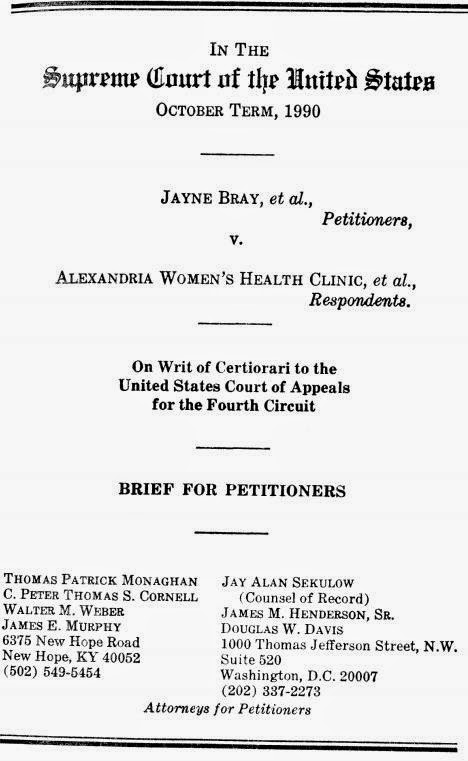
align persons of conscience today with racists of the past. Then, radical pro-abortionists responded to the peaceful, nonviolent actions of Operation Rescue by filing lawsuits under the "Ku Klux Klan Act of 1871." Imagine the kultur kampf had pro-abortionists succeeded in pinning the KKK moniker on pro-life demonstrators! Thankfully, the hard work and diligent research and writing that I, and others, lent to the battle resulted in the Supreme Court rejecting the application of the Ku Klux Klan Act to anti-abortion protests.

Still, there's nothing quite like skipping the engagement, nothing like not being put to the intellectual challenge of having your arguments sifted and measured by a reasoning mind, and nothing like going straight for the throat with a karate chop that stuns and blocks the windpipe. And that is precisely what is behind the effort to portray opposition to participation in same sex wedding ceremonies as the new "Jim Crow." Those who stridently charge that conscientious objection to participating in same sex wedding is the one and the same as the kind of brutal, dehumanizing discrimination and segregation of Jim Crow do so in what they hope will be a successful form of verbal martial arts.

So, it's important to understand the differences between conscientious objection by private citizens to engaging in conduct that violates their religious scruples and government coerced and directed segregation and discrimination. Having a full grasp of these points is an essential part of answering the questions that are popping faster than Orville's corn kernels in my microwave on the newest high contention issue of the 21st century.

Jim Crow Laws were precisely that:  laws.  Whether state laws, such as anti-miscegenation laws prohibiting racial intermarriage, or whether state laws like in Plessy requiring that transportation systems provide racially separated travel accommodations, or whether local ordinances requiring that parks and recreational facilities be racially separated. The dispute today is not over laws compelling segregation or discriminatory treatment. No one is being compelled by statute to separate Gays and Straights into separate accommodations. That is just not happening.

Here is what is happening.

As individuals begin to take advantage of this new-found right to "marriage equality," those individuals are, in fact, getting married. Some, of course, have quite publicly gotten married at courthouses and justices of the peace as soon as the right sprung. Others, however, more traditional of mind, are planning weddings. For them, unsurprisingly, the assistance of wedding services providers may be desired.

Wedding services providers include wedding planners, dress designers, printers, bakers, caterers, venue providers, and wedding performers including officiants, musicians, and DJs for receptions. As gay men and lesbian women seek out wedding services providers, they find some that gladly partner with them in creating a memorable wedding day and others that decline doing so. It appears that those declining to do so fall into a couple categories.

Of course, some service providers are overbooked and unavailable. No ground of complaint or controversy there. After all, if you arrive at Olive Garden or whatever you favorite eatery might be, and find you are facing a sixty minute wait, you might opt for a different provider. But controversy is arising in other cases, where wedding service providers decline to participate in the planning and execution of celebrations of same sex marriages based on religious scruples regarding marriage.

Among that smaller group, some of the refusals probably do not result in any further kerfuffle. That may be because the same sex celebrants take the refusal with a decent toleration for the sensibilities of others. Or, it may be that the service refusal occurs in a jurisdiction that does not treat religiously-based service refusals as a form of prohibited discrimination.

But, there is that smaller portion of total instances that comes to the public's attention. Disputes over refusals to make wedding cakes, provide floral arrangements, cater pizza receptions are being reported. (The Queer Eye for the Straight Guy really twitches every time it contemplates a pizza-based wedding reception -- unless the wedding toast is being done with a light pilsner.) Already there a small handful of administrative and judicial decisions has been generated arising from complaints that such service denials violate human rights codes or civil rights statutes.

Now the public conversation about these cases tells an ugly story.

More and more frequently, it appears that a kind of brutal and intolerant scheme is afoot. By that scheme, it is pretended that a view of marriage -- whether you share that view or not -- that has held sway for thousands of years, across hundreds of cultures, in dozens of religions, taught by well-regarded voices is, suddenly, a pernicious form of hatred, apparently the verbal equivalent to public lynching of blacks. As I have found myself saying, with algebraically increasing frequency, we are living in strange times.

Mind you, the marriage equality movement may prevail. If it does, that victory could be as soon as the end of June when the Supreme Court traditionally concludes its business by releasing decisions in any cases not yet decided from the current Term of Court. The same sex marriage cases being argued this week at the Supreme Court have the potential, if the Court reverses the decisions at issue,

If they do, then we can test whether those who prophesy the destruction of society are true prophets or false, simply by observing the progress of our society over time.

Whether they prevail or fail, we are threatened with greater losses.

First and foremost, as the bullies within the marriage equality movement (and that is, by no means, everyone in the movement) seek to arrest discourse by such attacks as the Jim Crow charge, there is a loss to liberty of discourse on matters of great public importance. This nation has always valued liberty of expression. We have sheltered even the expression of false facts from prior restraint, so great our commitment to that liberty has been.

Second, the demand that those that enjoy the natural right to liberty namely to engage in businesses, trades, and professions related to weddings, whether bakers, photographers, musicians, tailors and dressmakers, or the like, surrender their religious liberties as the price of doing so reflects a profound loss and harm. Our Nation was born because the previous governance here oppressed the enjoyment of the natural rights to life, liberty and the pursuit of happiness. The loss of the natural right to liberty embodied in conducting the affairs of one's profession or vocation is then compounded by the unreasoning attack on religious conscience.

I fear that some aspect of these losses will not even be missed. When Americans lose sight of Nature's God as the source of those rights, and concludes that these rights are granted by government, or by the Constitution, then they obtain an artificial spirit of objection to the stern stuff that are those natural rights. Ultimately, I don't have a sense that Americans will rise up in arms if this continues to spiral out of control, but if the statists continue to press for legal suppression of dissent and to punish conscience with economically fatal fines, the time for anger may slide into the time for the exercise of the right and duty to stated in the Declaration of Independence:
That whenever any Form of Government becomes destructive of these ends, it is the Right of the People to alter or to abolish it, and to institute new Government, laying its foundation on such principles and organizing its powers in such form, as to them shall seem most likely to effect their Safety and Happiness.